02 / System and research boundary
A field where carrying, resisting and beginning again remain unfinished.
Live trace relation / descriptive, never diagnostic
Trace tendency / not a personal state
Return to the field, press and draw. The changing relation below describes only how the current rule set reads that path.
No trace measured
QuestionHow might subtle change become perceptible without being represented, named or diagnosed?
ContributionA philosophical encounter reworked as an open, responsive field—not a symbolic illustration or a model of the viewer.
Working nowResampled curve geometry, independent trace relations and a low-resolution density and vector field operate in the browser. Coarse camera sensing remains optional; the M5Stack remains a separate prototype.
Next inquiryObserve 6–8 unguided encounters, compare differences and ambiguities in participants’ descriptions, then revise the rule mapping before spatial expansion.
System map / encounter → measurement → force → field
01 / EncounterPointer or cameraIntentional path / coarse frame change
02 / FeaturesCurve geometrySpeed / curvature / duration / spatial return / unvisited area / stillness
03 / RelationsIndependent signalsTrace: weight / friction / play · field: density / direction / persistence
04 / ConsequencePerceptual fieldFlow / interruption / opening / afterimage / decay
Current protocolSelect one condition. The field will reset before the timed run.
Current phaseWaiting for a condition
Run time00:00.0Not started
Speed—
Curvature—
Spatial return—
Duration—
Intersections—
Field density—
Direction memory—
Residues0
Observations0
Pointer distance0 px
Longest stillness0.0 s
Protocol—
Controlled field check / selected local prototype runs
01 / directional openingFast0.69 s · speed 1.59 · novelty 1.00
A brief directional disturbance opened unused space, then gradually decayed.
02 / sustained passageSlow7.22 s · speed 0.075 · Weight 0.71
Longer input built a denser field with stronger persistence.
03 / local durationStill28.5 s without added movement
Local residue gathered briefly, stabilised, and slowly lost density and direction.
04 / spatial returnRepeat3 paths · spatial return 1.00 · Weight 0.75
The first path opened space; return converted novelty into accumulation.
These hand-run checks verify differentiation between system rules. They are not participant findings and do not assign meaning, identity or psychological state to a viewer.
Three optional ways of entering the field
Agency and boundary
The visitor choosesWhether to move, wait, repeat, draw, enable the camera or leave.
The field receivesMovement, stillness, spatial relation and temporary low-resolution frame differences.
The field changesVisual density, continuity, instability, diffusion and persistence.
The system cannot knowIdentity, intention, emotion, belief or a person’s “true” metamorphosis.
Limits / open questions
Repetition is inferred from spatial overlap with earlier traces, while novelty means entering cells not yet visited in this session. These are operational definitions, not psychological facts. Screen size, pointer hardware, ambient light and familiarity with drawing interfaces can all change the result.
The camera reads only 48 × 36 luminance differences. Movement and brightness can be confounded, access is uneven across devices, and opting out must remain a complete version of the work. Nietzsche’s sequence is culturally and historically situated; this project’s coexistence model is an artistic reinterpretation rather than a universal account of transformation.
Sound is intentionally absent from the current prototype: it might make duration and accumulation more bodily, but it could also overstate a field designed to remain quiet and unresolved. A later comparison should test sparse sonic feedback as a temporal layer rather than assume that another medium automatically deepens the work.
The computation is exposed so that it can be questioned. The person remains unresolved.
01 / Project position and development
A field shaped by movement, stillness and what remains.
Core proposition
The work does not illustrate transformation as a sequence. It builds a field in which carrying, resisting and beginning can overlap and be felt without being named.
Nietzsche’s chapter “On the Three Metamorphoses” in Thus Spoke Zarathustra gave language to changes I recognised from lived experience. It prompted a further question: if a philosophical text can reorganise one reader’s perception, can an interactive field allow transformation to be encountered before it is explained?
Personal resonance / not autobiography
I had experienced carrying, resisting and becoming as real changes, but not as clean or dramatic stages. Even rupture did not feel like a spectacular collision. It appeared gradually and naturally, overlapping with responsibility, hesitation, curiosity and the making of new possibilities.
The work therefore does not retell my biography or assume that every visitor shares the same story. It uses that experience to ask whether subtle internal change can become perceptible without being explained, diagnosed or represented literally.
Research contribution
Rather than translating Nietzsche’s three figures into images, the project draws from bearing, refusal and beginning again as provisional forces that can overlap, recur and remain unfinished within the field.
Research questions
01Translation→How can a philosophical reading become responsive conditions without being reduced to symbolic images?
02Perception→Can qualities of carrying, resisting and beginning be encountered through density, interruption and opening without naming or judging the viewer?
03Embodiment→How do directional input, bodily presence and a physical threshold alter the way a field is entered and experienced?
Three coexisting forces / not a fixed sequence within the field
01 / CamelWeight
Burden, endurance, repetition, lingering and accumulation.
02 / LionFriction
Resistance, contradiction, interruption, displacement and rupture.
03 / ChildPlay
Exploration, connection, opening, creation and new possibility.
Nietzsche describes three metamorphoses in sequence. This work does not replace that structure with a universal theory: it holds Weight + Friction + Play together because lived change felt overlapping and unfinished. These relations shape the field; they do not identify, limit or define the viewer.
Geometric field model / two linked rule layers
01Trace analysisArc-length sampling / speed / duration / curvature / intersections / spatial return / exploration
02Trace relationEach path produces independent, coexisting Weight / Friction / Play signals
03Residue fieldA low-resolution density and vector field retains local direction, diffuses it and gradually lets it decay
04Shared visual grammarDust / trace / blur / noise / afterimage / displacement produce density, rupture, residue and opening
Technical note / inspect the hand-authored mapping
WWeightincreases with slower movement + prior spatial overlap + longer duration
FFrictionincreases with curvature + abrupt turns + self-intersection
PPlayincreases with unvisited space + directional continuity + spatial extension
Model statusHand-authored and tuneable. The three signals are independent and may coexist; they are not machine-learned predictions or labels assigned to a person.
Rule evidence / input → state change → perceptual consequence
EncounterRuleVisible consequence
MoveMovement deposits an active trace.A path extends and disturbs the existing field.
PauseShort stillness gathers residue locally.Density forms around the last position.
RemainLonger stillness changes accumulation and decay.The image thickens, diffuses or leaves an afterimage.
RepeatSpatial return increases local density and retention.The familiar path becomes thicker and remains longer.
TurnCurvature, abrupt direction and self-intersection increase rupture.Continuity briefly separates, shifts or leaves a gap.
ExploreEntering a low-density or unvisited area increases emergence.Sparse points establish a new local direction.
Two inputs / two kinds of presence
Mouse / intentional movement
Precise, directional, trace-making
Movement establishes direction and fine trace. Repetition builds local density; abrupt changes introduce friction; exploratory paths open unused space.
Optional camera / coarse visual change
Atmospheric, frame-based, less precise
If the visitor actively enables it, low-resolution luminance differences detect coarse movement and brightness change in the camera frame. These signals affect global pressure, breathing and instability differently from the mouse.
Current camera test / reflection
The camera was introduced to test a kind of presence that is atmospheric rather than directional. In the current prototype, larger changes in the frame intensify bright points and can produce an expansive burst.
That response may be too explosive for the project’s quieter logic. The next iteration will test global pressure, breathing and brief instability without treating the camera as another drawing instrument or assigning meaning to the body it senses.
Camera ethicsOpt-in only. A 48 × 36 luminance sample is processed locally and temporarily; no image is displayed, stored or transmitted, and no identity recognition is used. The field remains usable without camera access.
Restricted visual primitive library
DustTraceBlurNoiseAfterimageDisplacement
Development trajectory
The project began as a non-interactive particle state. Through iterative web experiments, interaction entered gradually: first through mouse direction and trace, then through optional low-resolution camera sensing as an attempt to introduce a different kind of movement, rhythm and breath.
Particles, diffusion and water-like movement were chosen because the three forces felt microscopic, elusive and continuously flowing. Brighter halos, decorative light and firework-like effects were tested and rejected: their visual impact made transformation appear more violent and theatrical than it felt in lived experience.
01 / Initial stateParticlesNon-interactive matter in continuous transition.
02 / Direction entersMouse traceIntentional movement gives the field a local path.
03 / Body entersCamera presenceCoarse movement and brightness change affect the field as atmosphere.
Visual development / not three metamorphosis stagesParticle state → directional input → embodied input
Practice-based methodology
01MapTranslate philosophical qualities into behavioural conditions
02BuildDevelop a restricted visual grammar through creative coding
03TuneAdjust parameters through repeated perceptual and embodied tests
04ObserveCompare participant descriptions without giving philosophical labels in advance
05ExpandTranslate the tested interaction from screen to threshold and spatial field
Working now / two real prototypes
Web Field + M5Stack
The live field, mouse response, opt-in coarse camera sensing and handheld entry test are current working experiments. The Web Field and M5Stack remain technically separate.
Next research stage
Differentiate → map → observe
Strengthen the difference between mouse and camera, clarify how each rule changes the visual field, then observe encounters before technical integration.
Participant observationNot yet conducted. A planned first study with 6–8 consenting participants will combine a short unguided interaction with a post-interaction description, then compare the language, differences and ambiguities that emerge before relating them back to the visual rules. Philosophical terms will not be given in advance, and camera use will remain optional.
The field does not tell the viewer what state they are in. It changes with the way they enter it.
03 / Spiritual interface prototype
A physical threshold, not a remote control.
The M5Stack Cardputer ADV tests what changes when a philosophical encounter becomes handheld, private and intentional. Its small display, physical keys and intervals of waiting create a threshold before the viewer enters the perceptual field.
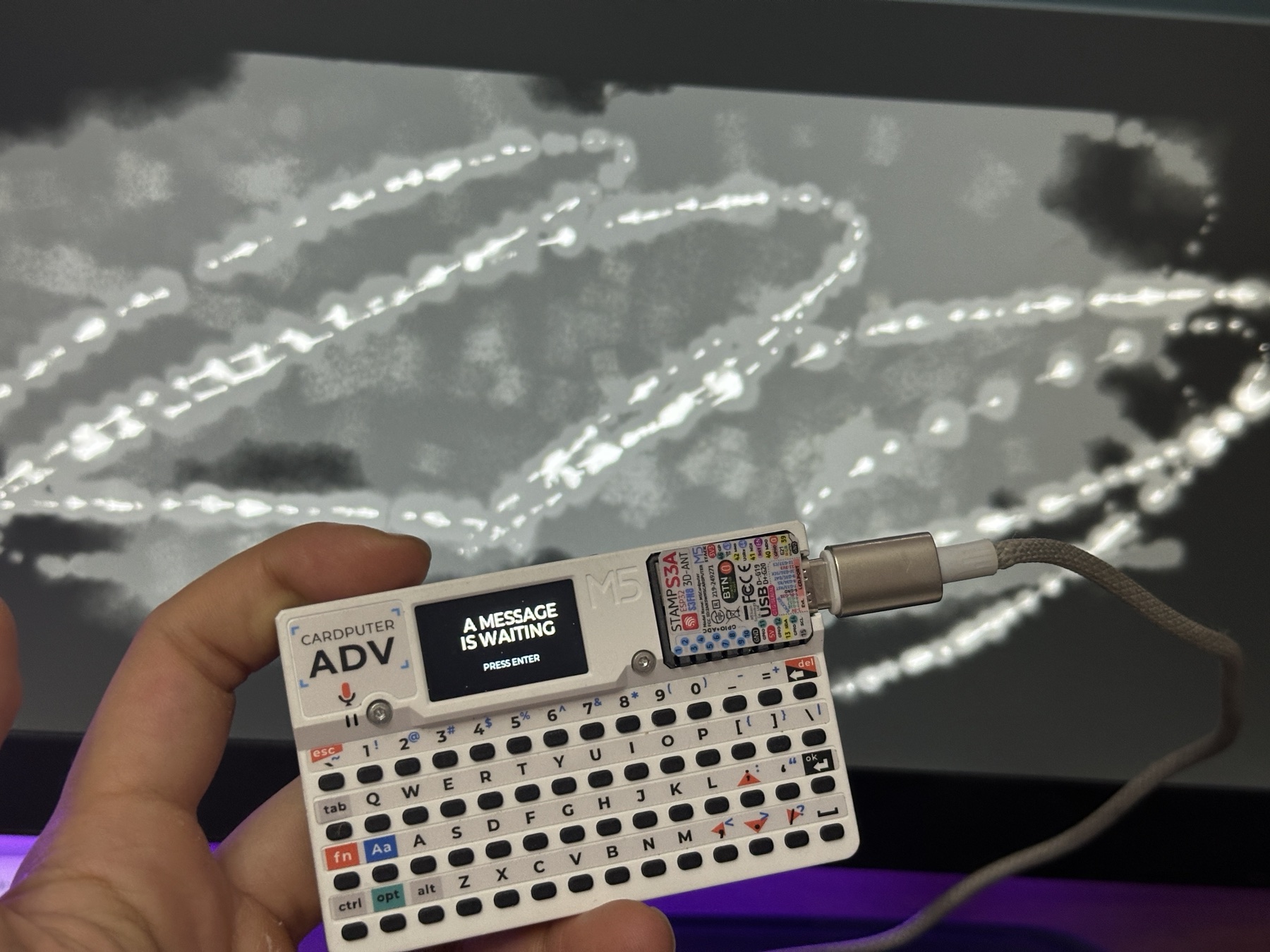 01 / Device and field — two current prototypes in relation
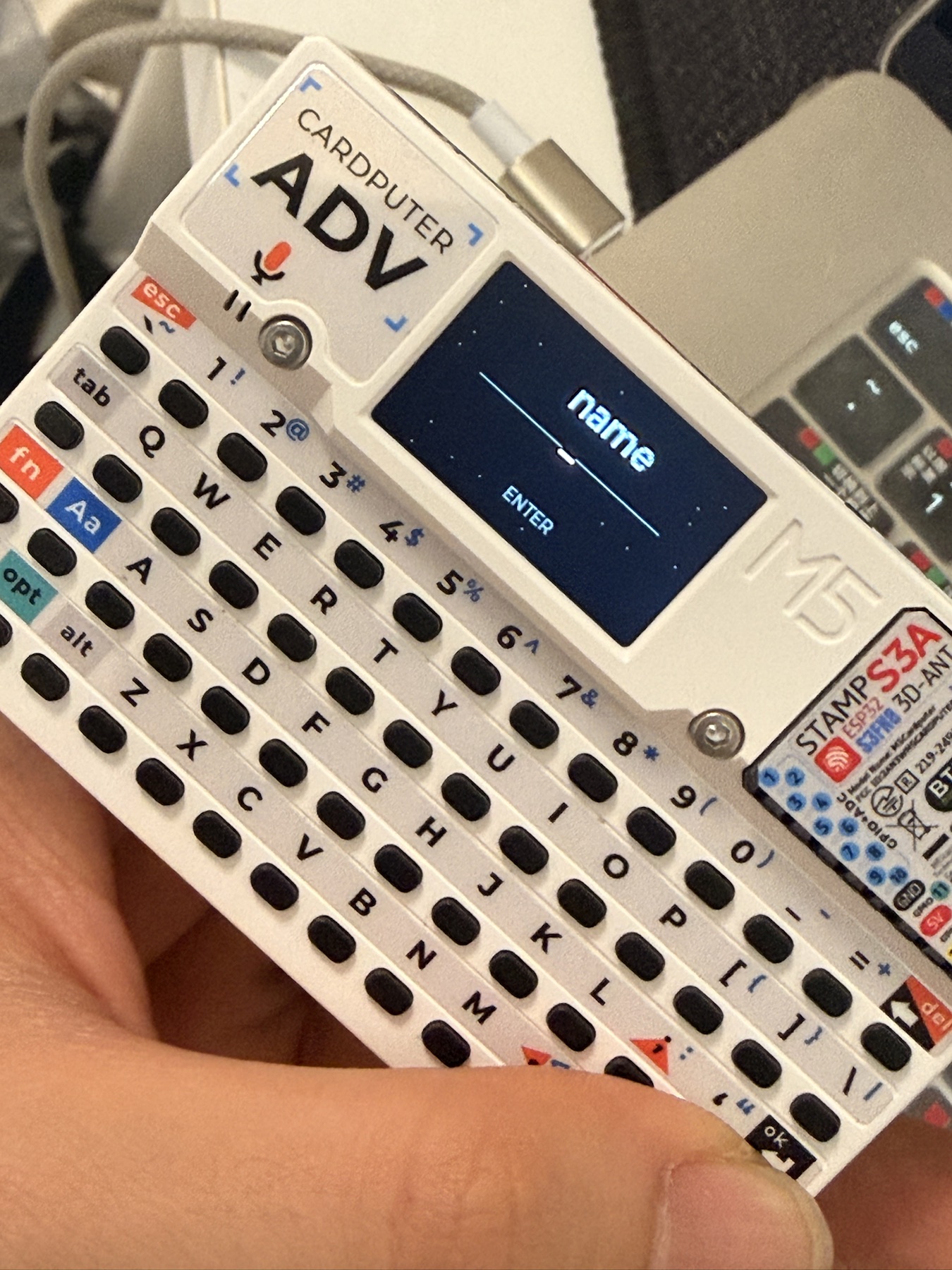 02 / Name entry — a physical gesture of arrival
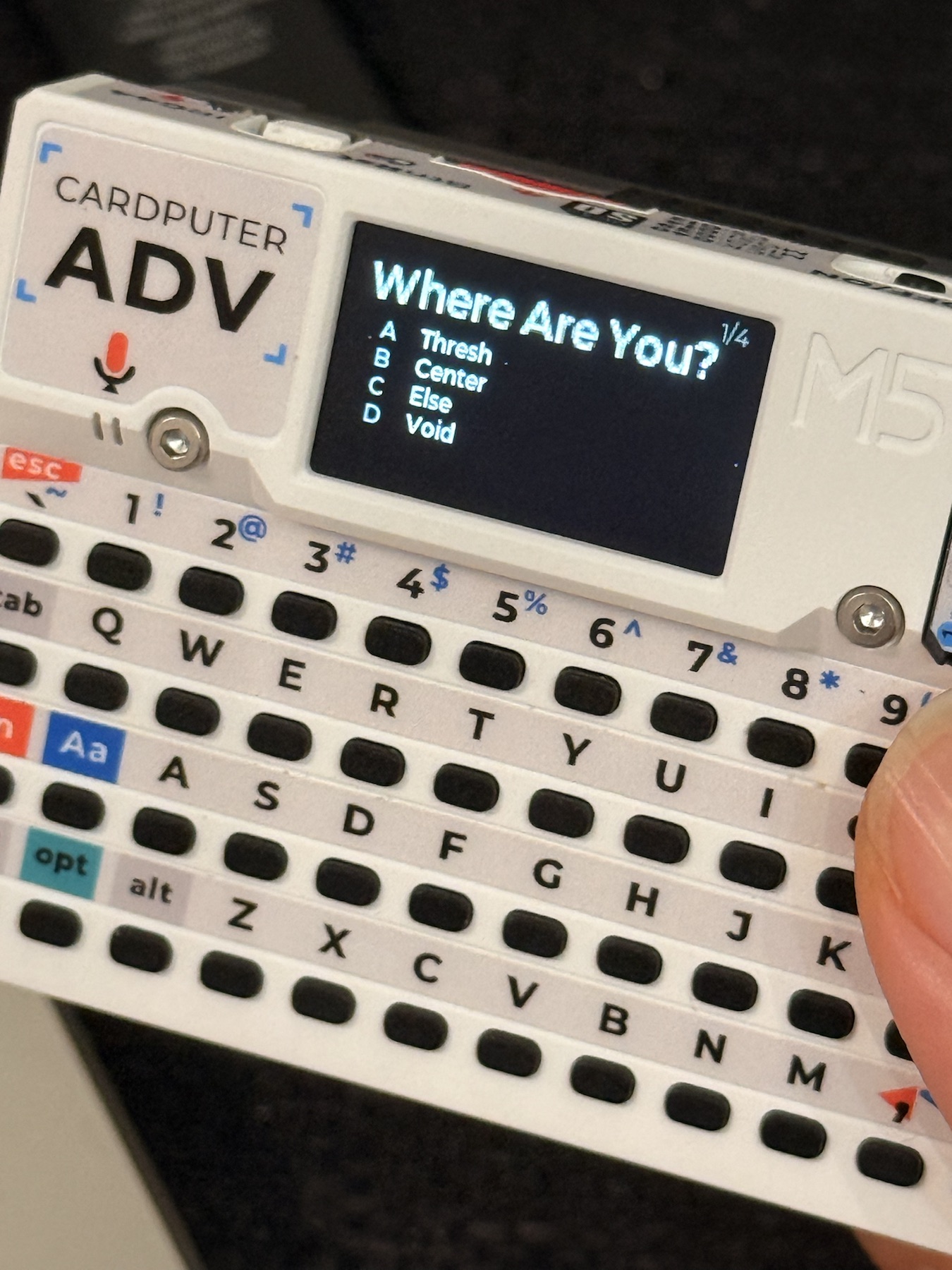 03 / Variable prompt — one question within a changing sequence
Evidence statusThe photographs document the working standalone interface. Communication between the device and Web Field has not yet been implemented, and the prompt archive and response wording remain under revision.
01Boot
THE THREE METAMORPHOSES
02Name / entry
ENTER YOUR NAME
03Waiting
A MESSAGE IS WAITING
04Three prompts
Three questions are drawn from a changing set. The sequence differs between encounters and the participant answers using the physical keyboard.
05Open response
After the three answers, the interface returns one short fragment from a variable set. It leaves a thought open rather than producing a score, diagnosis or fixed metamorphosis.
Conceptual relationship / technically separate today
01M5Physical entry interface / name, waiting, three variable prompts and an open response
02WebPerceptual field / movement, stillness, repetition and presence become visual conditions
03LaterM5 entry state activates the web or spatial field through a local connection
Minimum viable connection / proposed test
01Send one eventThe device sends entry:ready only after the reflective sequence is completed
02Keep it localA local WebSocket carries no name, prompt text or written response
03Change one conditionThe Web Field begins a temporary inhale and lowers its rate of decay
04Expose the boundaryConnection state and latency are documented; failure leaves the field independently usable
Implementation statusProtocol proposal only. It connects the completion of a threshold, not the content of a person’s responses; no interpretation, scoring or response transmission is required.
Here “spiritual interface” means a reflective, philosophical threshold rather than a religious claim or psychological instrument. Entering a name is a temporary gesture of arrival. Randomised prompts and variable responses prevent a single prescribed path, but the interface does not score, diagnose or tell the participant which metamorphosis they are.
04 / Speculative spatial development
The same perceptual system, expanded from screen to space.
The future installation is not a separate artwork. It translates the current digital and handheld experiments into a physical threshold where whole-body movement extends the directional role of the mouse and residue occupies projection, surface and atmosphere.
Translation of scale
01Mouse→ body movement
02Browser screen→ spatial perceptual field
03M5 input→ threshold interface
04Camera presence→ spatial sensing
05Digital residue→ projection / surface / material residue
Three spatial components
01 / EntranceSpiritual Interface
A small, deliberate entry action acknowledges presence before activation.
02 / TransitionThreshold
A membrane, slit or partial opening marks passage without becoming a theatrical portal.
03 / InteriorPerceptual Field
Projection, scrim and exposed structure hold a quiet, incomplete and responsive condition.
Installation overview01 / 04
Speculative Installation Proposal, 2026AI-assisted spatial visualisation developed from the current working prototype.