CURRENT PRACTICE / 03
THREE STATES
OF ORDER
Beijing Orders
One material prototype · Two speculative visual studies · Interactive binding study
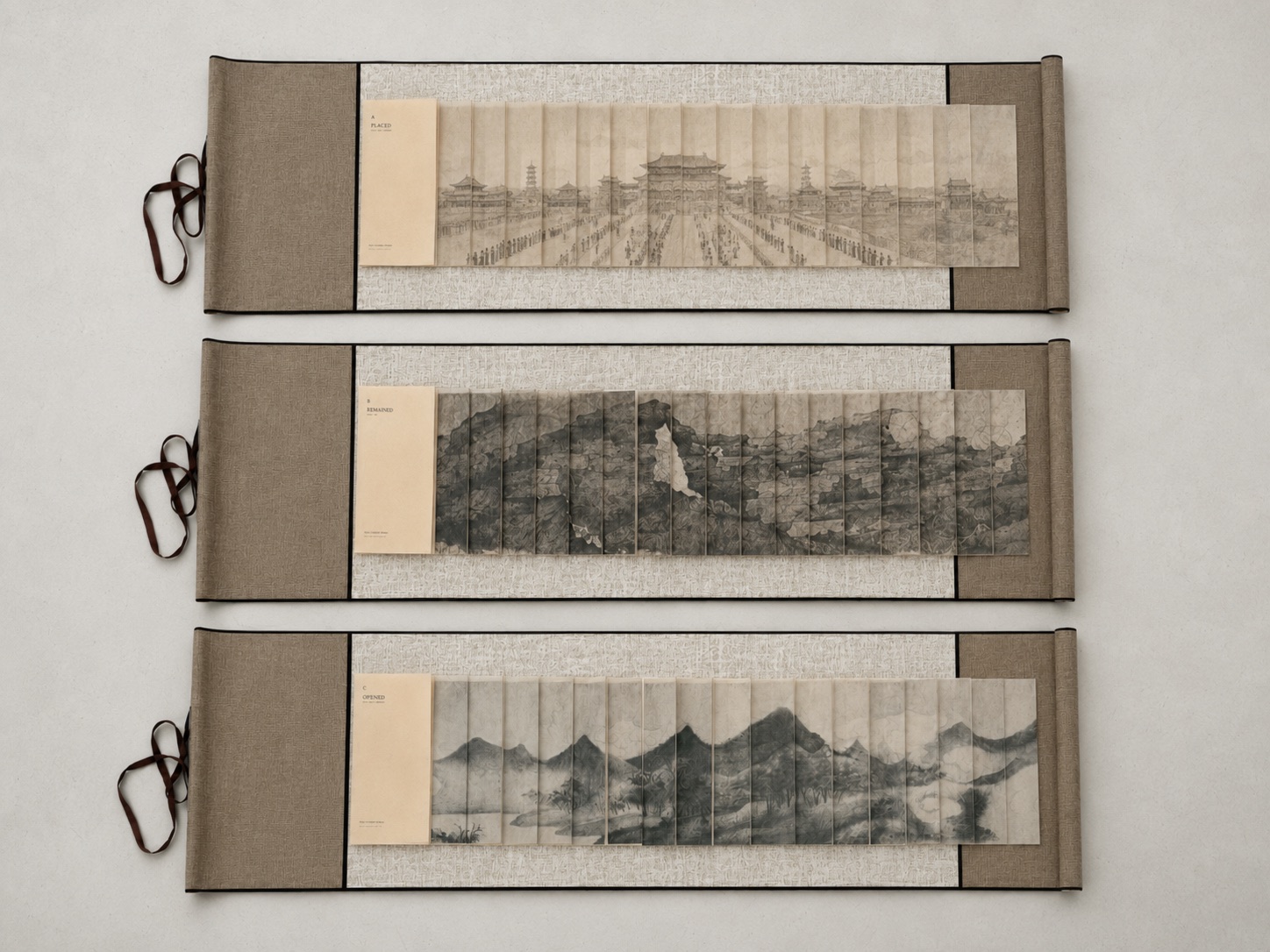
Project
Introduction
Three States of Order (Beijing Orders) began with the bodily experience of moving through Beijing’s architectural and historical spaces. Rather than describing the city’s appearance, it asks: how might bodily encounters with historical order be translated into a material and temporal structure of reading?
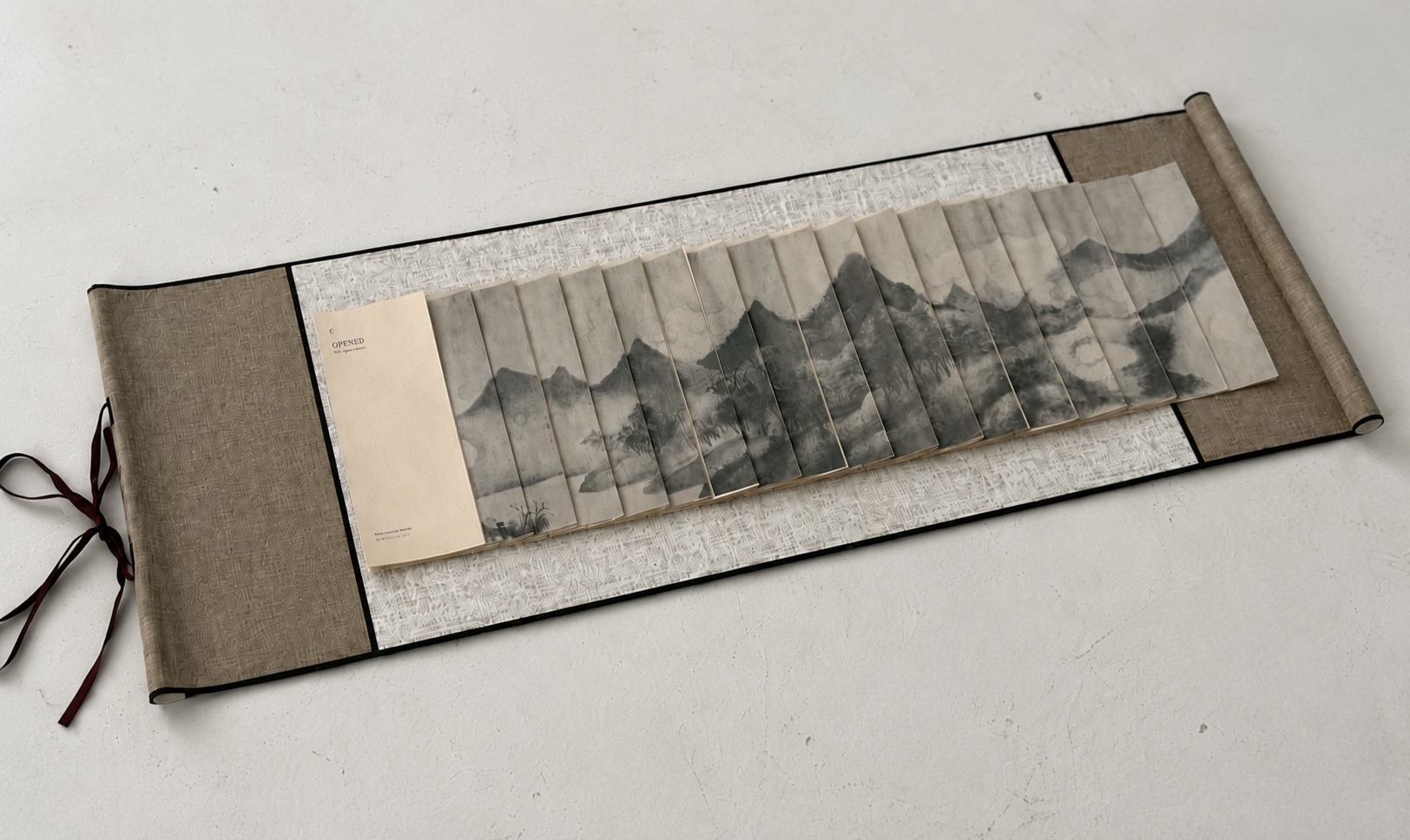
These spatial relations are translated into a temporal structure of reading through dragon-scale binding. One hand-made material pilot—C / Opened—establishes the physical system. A / Placed and B / Remained extend that system as speculative digital visualisations of two further states of order.
Beijing is the site of encounter rather than the literal subject of every image. Historical paintings are used as working visual fields through which relations first observed in the city—axis, hierarchy, procession, interval and trace—can be tested.
01
ENCOUNTERING ORDER
Field observation and sketchbook studies across the Forbidden City, Beijing’s central axis, the Summer Palace and Yuanmingyuan focused on how order is encountered through the body: repeated gates, prescribed routes, symmetrical structures, material surfaces, distance, stopping and moments of partial visibility.
The research moved away from recording particular sites and towards isolating the relations that organise perception: axis, procession, hierarchy, repetition, density, interval and trace.
02
THREE MODES OF ENCOUNTER
These are not three equivalent conditions contained in objects, but three modes through which a body encounters historical order: being positioned by it, meeting its residues, and making it perceptible through movement and attention.
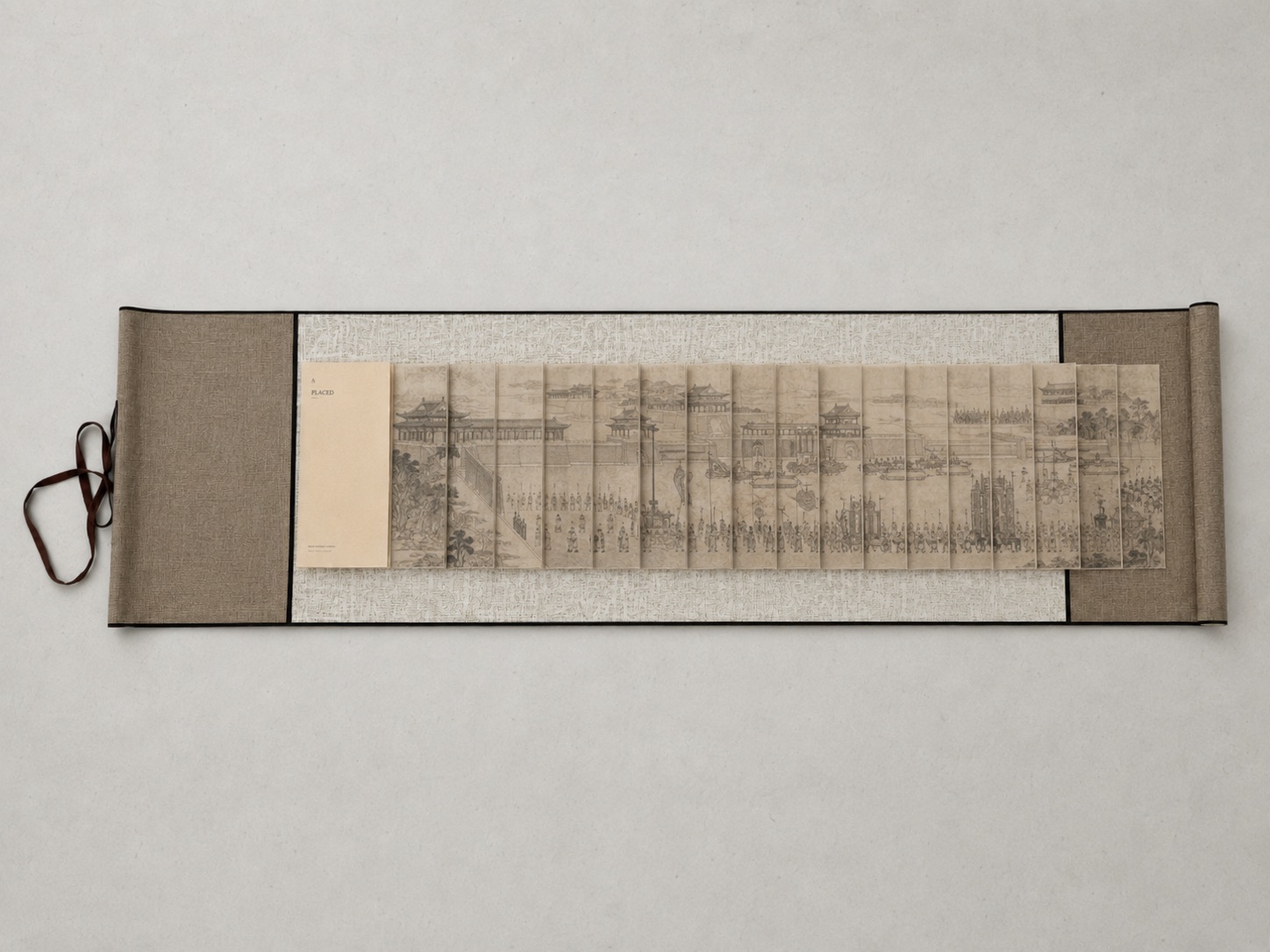
A / PLACED
The body is positioned by order.
Axis, procession, architecture, ritual and prescribed position.
- Body relation
- Positioned by axis, route and hierarchy.
- Visual source
- Wanshou Shengdian Tu, c. 1717
- Operation
- Extracting routes, queues, gates, density and alignment.
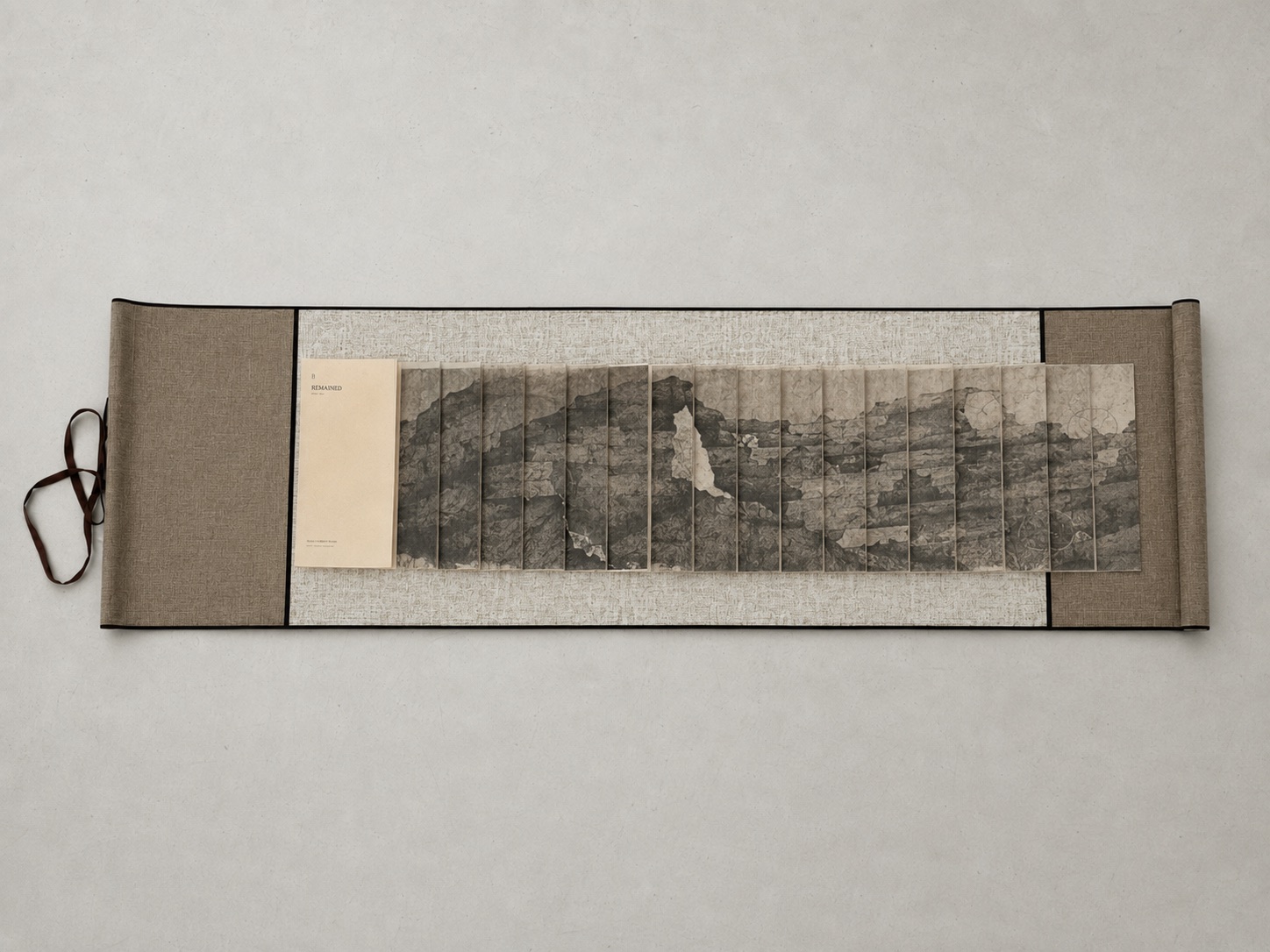
B / REMAINED
The body encounters the remains of order.
Stone, surface, sediment, rupture, erosion and material residue.
- Body relation
- Confronted by fragment, rupture and persistence.
- Visual source
- Mountain-and-stone imagery associated with Rivers and Mountains Stretching for Thousands of Miles
- Operation
- Extracting pores, cracks, shadows and layered stone surfaces.
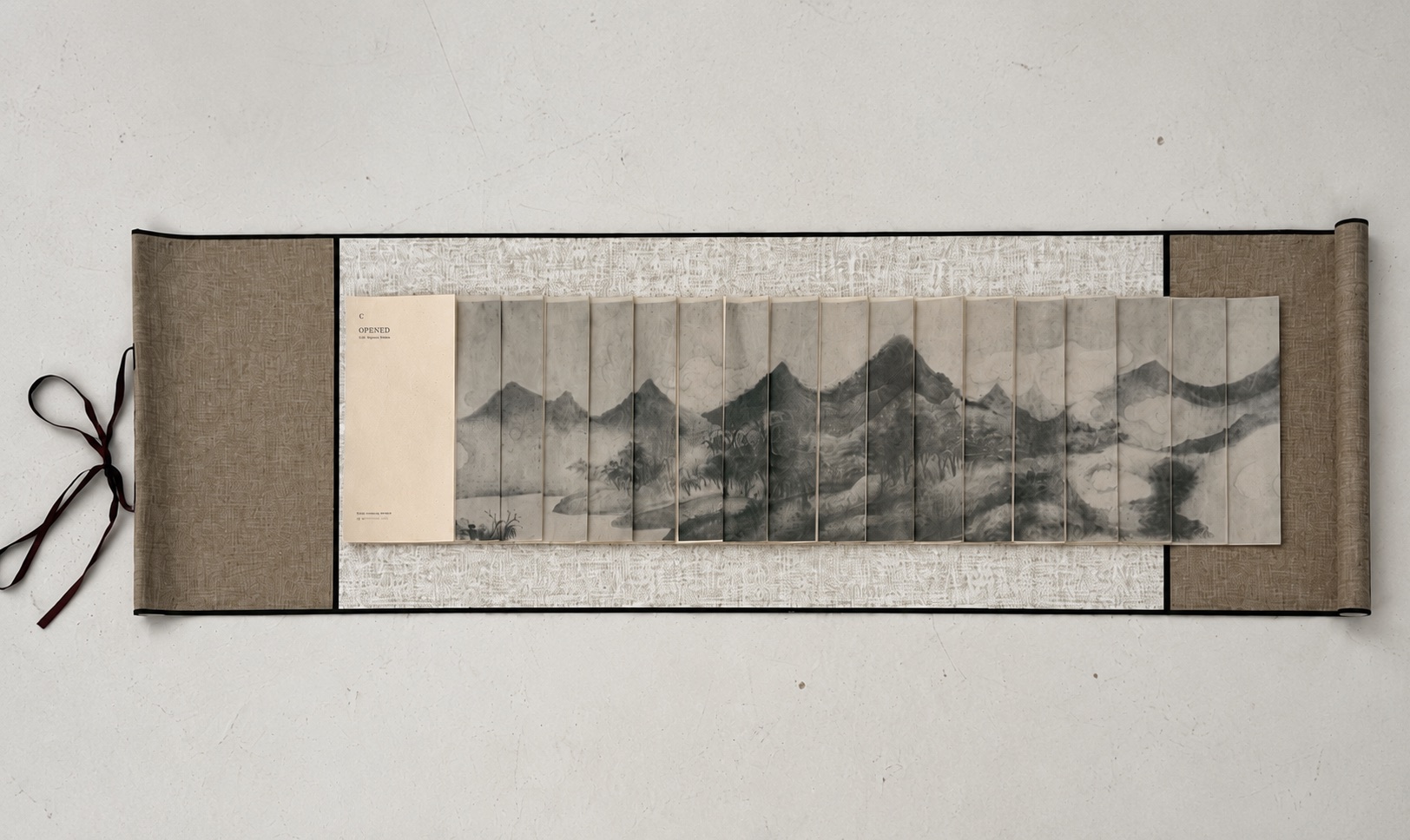
C / OPENED
The body makes order perceptible through action.
Mist, mountain, interval, absence and gradual appearance.
- Body relation
- Revealed through opening, pause, return and touch.
- Visual source
- Mi Youren, Wondrous Views of Xiao and Xiang, 1135
- Operation
- Using gaps, overlap and pale tonal shifts to stage gradual revelation.
03
STRUCTURAL TRANSLATION
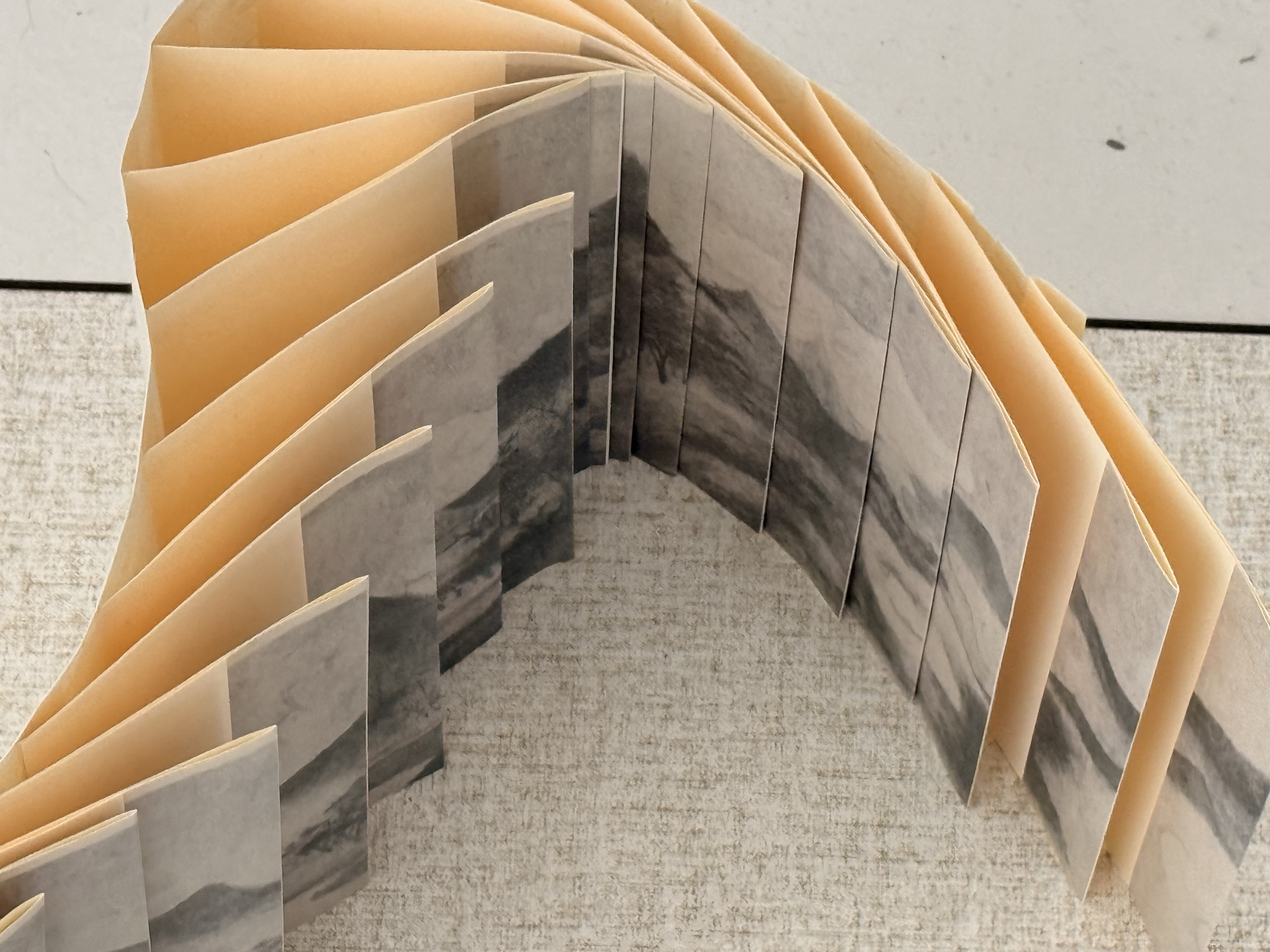
Dragon-scale binding is used as an operative structure rather than a decorative sign of tradition. Each leaf occupies a defined position, overlaps another and can only be read through a sequence of lifting, revealing and returning.
The textile mount, continuous base and overlapping leaves form one object. It unfolds for reading and rolls back together; it is not a separate book placed on a scroll.
The work does not reconstruct a historical specimen. It uses the binding’s overlapping and sequential logic as a contemporary method for testing how spatial order can become bodily, temporal and only partially visible.
04
MAKING THE MATERIAL PILOT
The structure was discovered through printing, cutting, folding and repeated assembly. Screen-based continuity changed when it met paper: edges, friction, bending, shadow and slight misalignment became active parts of the work rather than imperfections to remove.
05
THE SERIES
CONCEPTUAL ORDER / PRODUCTION PATH
The series is read conceptually as Placed → Remained → Opened. Its production developed in the opposite direction: the hand-made Opened prototype provided the material and structural basis from which Placed and Remained were visualised digitally.
A / DIGITAL STUDY
PLACED
Order as positioning, alignment and ritual sequence.
Procession, architecture and axial organisation are arranged across the overlapping leaves as a world in which every element appears to occupy a prescribed position.
B / DIGITAL STUDY
REMAINED
Order as residue, sediment and material persistence.
Dense stone surfaces, rupture and the irregular pale gap treat history as something that remains materially present after its organising function has receded.
C / PHYSICAL PROTOTYPE
OPENED
Order as interval, unfolding and perceptual revelation.
Mist, distance and absence become gradually perceptible between pale overlapping leaves. This is the completed hand-made material pilot for the series.
INTERACTIVE BINDING STUDY · COVER → A / FRONT ↔ B / REVERSE00 / 17
DRAG LEFT → RIGHT · FIXED EDGE / FREE EDGE · ← → ONE LEAF AT A TIME
06
MATERIAL READING
The prototype is not completed by being seen as a fixed image. Its structure asks for touch, lifting, hesitation and return. Fibres, folds, page edges and small variations in alignment make reading dependent on the duration and pressure of the hand.
Making also complicated the project’s initial idea of order. Small deviations introduced by the hand did not weaken the structure; they made order perceptible as something negotiated between a system, its materials and the body reading it.
07
NEXT INQUIRY
The material pilot has established a viable structure and a method for translating spatial relations into sequential reading. The next stage is reader observation. A small handling study will examine how participants open, pause, reverse and re-roll the object, and whether the intended states of positioning, residue and gradual appearance remain perceptible without prior explanation.
RQ 01 / Reading structure How does dragon-scale binding shape sequence, hesitation and return during reading?
RQ 02 / Physical–digital translation What is lost or transformed when a material reading action becomes a screen interaction?